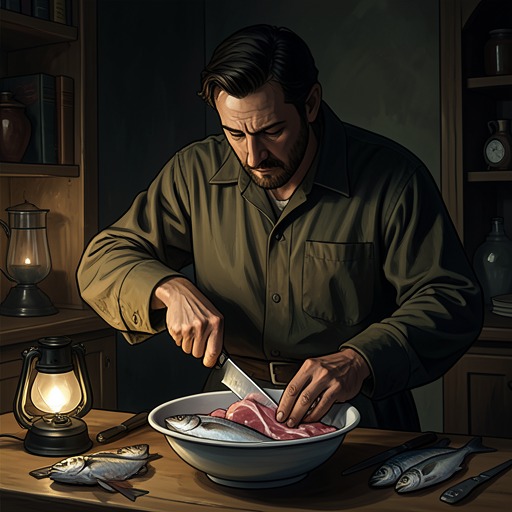
Fishing Hooks
Life of PiFishing Hooks serve as instruments of survival at sea, but their effectiveness depends on more than the hook itself: the prey must be caught, and the bait must hold. Across Pi Patel’s account, attempts to use hooks reveal both the narrow chances of obtaining food and the brutal improvisations that starvation makes possible.
A Tool for Catching Food
Pi Patel tries to catch a short-tailed shearwater by baiting a hook with a piece of Flying fish. With no weights on the line, he struggles to bring the bait within reach. On his third attempt, the bird paddles to it and plunges its head underwater; Pi waits several seconds before pulling. The bird squawks and regurgitates the bait, then flies away before he can try again. The hook offers a chance, not a guarantee: even a bird close enough to take the bait can escape.
When Bait Fails
The account of the Taiwanese sailor makes the hook’s dependence on its bait more literal. After the Cook amputates the sailor’s leg, he tries to use it as bait, but the dead flesh is too decayed to stay on the fishing hook. It dissolves in the water. The failure is not a shortage of material but its condition: the body that the Cook has turned into a resource cannot serve its intended purpose. The hook cannot make unusable bait hold together.
Hooks and the Extremity of Survival
Later, Pi Patel confesses to catching one of the dead castaway’s arms with a gaff and using flesh as bait. He also admits that, driven by extreme need, he ate small strips of the man’s flesh, stopping when he caught a fish. The gaff is a distinct implement from a fishing hook, but the episode belongs to the same material logic of capture: a tool turns a piece of the dead into a means of securing food. Set beside the failed attempt with the sailor’s decayed leg, this use makes survival depend on the precarious fit between implement, bait, and need.